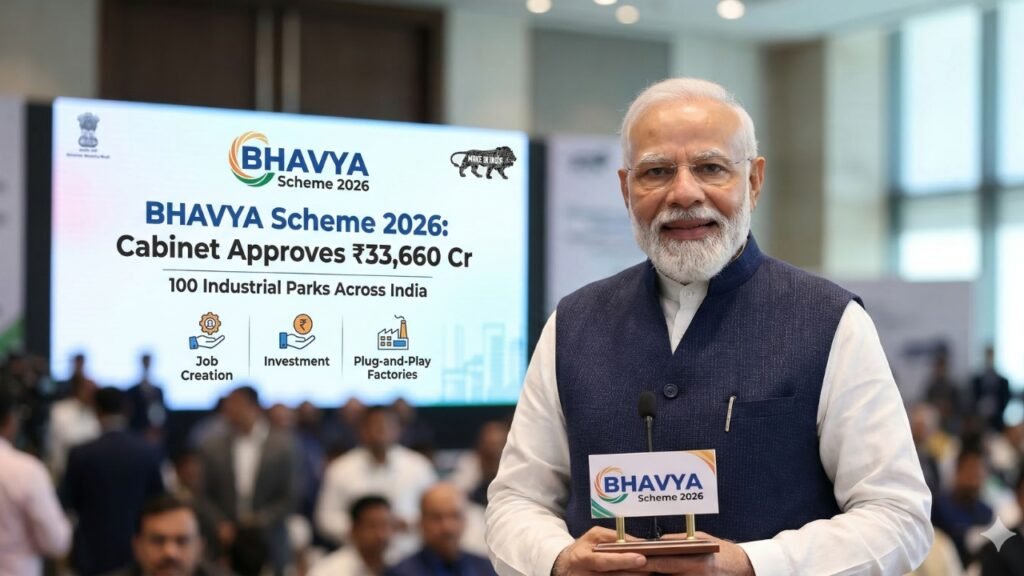
On Wednesday, the Union Cabinet, chaired by Prime Minister Narendra Modi, approved a groundbreaking initiative called the Bharat Audyogik Vikas Yojna (BHAVYA). On Wednesday, the Prime Minister Narendra Modi approved Bharat Audyogik Vikas Yojna (BHAVYA). The government will spend a huge amount of money, ₹33,660 crore, on this plan. This scheme will change how factories work in India. The government wants to build 100 special industrial parks by the year 2032. These parks will be spread across the whole country. These parks will be “ready-to-use” for businesses. This big move will bring in lots of money from other countries. It will also create millions of new jobs for people. This helps make the “Make in India” dream come true.
What is the BHAVYA Scheme?
The word “BHAVYA” stands for Bharat Audyogik Vikas Yojana. It is a strategic program designed to provide ready-to-use infrastructure for industries. Instead of buying raw land and spending years getting approvals, companies can simply “plug in” and start manufacturing. This “plug-and-play” model removes the biggest hurdles for new businesses: time and red tape.
Key Highlights of the Scheme
| Feature | Details |
| Full Name | Bharat Audyogik Vikas Yojna (BHAVYA) |
| Total Budget | ₹33,660 Crore |
| Goal | Build 100 “Plug-and-Play” Industrial Parks |
| Deadline | All parks to be ready by the year 2032 |
| Phase 1 Target | 50 parks to start in 2026-27 |
| Money for Land | Up to ₹1 Crore per acre for internal facilities |
| Land Size | 100 to 1,000 acres (25 acres for Hilly/NE States) |
| Main Benefit | Ready-to-use factories with power, water, and roads |
| Job Creation | Expected to create about 15 lakh (1.5 million) direct jobs |
| Selection Method | “Challenge Mode” (States compete for projects) |
Why Did the Cabinet Approve BHAVYA?
Prime Minister Narendra Modi hailed the Cabinet’s decision as a “historic step.” The goal is to make India a preferred destination for global investors. Currently, many companies are looking for alternatives to traditional manufacturing hubs. India wants to capture this opportunity by offering ready-made industrial spaces. Union Minister Ashwini Vaishnaw explained that India is now seen as a reliable partner in the global supply chain. By providing certain policies and skilled talent, the BHAVYA scheme will act as a catalyst for economic growth.
The “Plug-and-Play” Advantage
The most exciting part of this scheme is the Plug-and-Play concept. But what does it actually mean for a business owner?
Normally, setting up a factory in India involves several steps:
- Finding and buying land.
- Getting environmental and local clearances.
- Building roads and utility lines.
- Setting up power and water connections.
Under the BHAVYA scheme, the government does all the heavy lifting. The industrial parks will have pre-approved land and ready-to-use infrastructure. A company can move into a pre-built factory shed, connect to the existing power grid, and start production almost immediately. This reduces the “Go-to-Market” time significantly.
Funding and Infrastructure Support
The Central Government is not just making rules; it is providing heavy financial backing.
- Financial Aid: The government will provide up to ₹1 crore per acre for core infrastructure.
- Core Facilities: This includes internal roads, drainage systems, underground utilities, and water supply.
- Value-Added Services: The parks will feature testing laboratories, warehouses, and customized factory units.
- Social Infrastructure: To support workers, the scheme includes the construction of housing, canteens, and healthcare facilities near the industrial sites.
Strategic Integration with PM GatiShakti
The BHAVYA scheme is not an isolated project. It will be integrated with the PM GatiShakti National Master Plan.
This integration ensures that every industrial park has excellent connectivity. Whether it is a highway, a railway line, or a nearby port, these parks will be linked to India’s logistics network. Better connectivity means lower transport costs. When logistics costs go down, Indian products become cheaper and more competitive in the global market.
Scope and Selection Process
The government has set clear guidelines on the size and location of these parks:
- General Areas: The minimum land requirement is 100 acres.
- Hilly and North-Eastern States: To encourage development in difficult terrains, the minimum size is reduced to 25 acres.
- Maximum Size: A single park can go up to 1,000 acres.
How are locations chosen?
The government will use a “Challenge Mode” to select projects. States and private partners will submit proposals. The Centre will then pick the best, most reform-oriented, and investment-ready proposals. This creates healthy competition among states to offer the best facilities to industries.
A Six-Year Roadmap (2026-2032)
The BHAVYA scheme is a long-term vision. According to Amardeep Singh Bhatia, Secretary of the DPIIT, the scheme will run for six years.
- Phase 1 (FY27 onwards): The government will initiate the development of the first 50 parks.
- Phase 2: The remaining 50 parks will be developed to reach the target of 100 by 2032.
This phased approach allows the government to learn from the first set of parks and improve the second set.
Who Will Benefit from BHAVYA?
This scheme is a win-win for multiple stakeholders in the Indian economy:
1. Global Investors
Large multinational corporations (MNCs) seeking a stable environment will find these parks attractive. Pre-approved clearances mean they do not have to deal with slow local bureaucracy.
2. MSMEs and Startups
Small and medium enterprises often lack the money to build massive factories. The ready-built sheds and shared facilities like testing labs will lower their costs.
3. The Local Workforce
The scheme will create millions of direct and indirect jobs. Since the parks include worker housing and amenities, it ensures a better quality of life for laborers.
4. State Governments
States that participate will see an increase in tax revenue and regional growth. It helps in the balanced growth of various districts across the country.
Environmental and Sustainable Focus
Modern industry cannot ignore nature. The BHAVYA scheme incorporates “Green” practices. The parks will focus on:
- Use of Green Energy (Solar and Wind).
- Integrated underground utility corridors to prevent frequent digging.
- Efficient waste management and drainage systems.
- Preservation of local ecology during construction.
The Bharat Audyogik Vikas Yojna (BHAVYA) is more than just a funding announcement. It is a blueprint for a modern, industrial India. By spending ₹33,660 crore, the government is building the foundation for a massive economy. With 100 new industrial parks, India is sending a clear message to the world: “We are ready for business.” The combination of GatiShakti connectivity, plug-and-play facilities, and single-window clearances will likely turn the “Make in India” dream into a reality.
Official Helpline & Contact Table
| Entity | Contact Type | Details |
| DPIIT Helpdesk | General Phone | +91-11-23061222 |
| DPIIT Secretary Office | Phone (Direct) | 011-23038850 / 011-23038851 |
| Official Email | DPIIT Secretary | secy-ipp@nic.in |
| NICDC (Implementation) | General Email | contactus@nicdc.in |
| Alternative Portal | Invest India | https://www.investindia.gov.in |
| Address | Head Office | Vanijya Bhawan, New Delhi – 110001 |
Frequently Asked Questions (FAQs)
1. What is the full form of BHAVYA?
BHAVYA stands for Bharat Audyogik Vikas Yojna.
2. How much money has the government approved for the BHAVYA scheme?
The Union Cabinet has approved an outlay of ₹33,660 crore.
3. How many industrial parks will be built?
The government will develop a total of 100 industrial parks across India.
4. What is a “plug-and-play” industrial park?
It is a place where land, electricity, water, and factory buildings are already ready. Companies can start their work immediately without waiting for construction.
5. When will the BHAVYA scheme start?
The first phase will begin in the financial year 2026-27, starting with 50 parks.